Wakeboarding Photography: How to Shoot Cable Parks and Boat Sessions
Published 18 June 2026
Wakeboarding photography differs from surf or kite photography in a fundamental way: the environment is largely controlled. At a cable park, the rider always crosses the same path. On a boat session, the distance and angle are predictable. This predictability is a significant advantage — but it creates its own challenges around angles, backgrounds, and making constrained setups look dynamic.
Cable park photography
Cable parks are actually excellent environments for photography beginners. You know exactly where the rider will be at any moment, which eliminates the wave-reading and positioning guesswork that makes ocean photography challenging.
Positioning at a cable park
At the obstacles: The jumps, kickers, and sliders are where the most dramatic moments happen. Position yourself:
- At the end of a kicker, shooting toward the rider coming off the lip — you see the full aerial
- Slightly to the side of obstacles, showing the rider's body position relative to the feature
- At water level when possible — this angle makes aerial tricks look higher and more dramatic
Consider the background: Cable parks often have cluttered backgrounds — fences, parking lots, buildings. Choose your position carefully to minimise distracting elements. A background of water and sky always beats one of industrial infrastructure.
Use an overpass or elevated platform: Many cable parks have bridges or elevated walkways. Shooting from above a kicker as a rider airs off it creates a dramatic downward perspective.
Settings for cable park photography
| Setting | Value |
|---|---|
| Shutter speed | 1/3200–1/4000s |
| Aperture | f/5.6–f/8 |
| ISO | 200–400 (usually good light) |
| AF mode | Continuous tracking |
| Drive | High burst |
Cable parks are typically in open sun — light is rarely the limiting factor. The priority is freezing fast trick motion.
The predictability advantage
Because the cable path is fixed, you can pre-focus on a specific point before the rider arrives. This gives you an edge over camera-based tracking alone:
- Focus on the spot where the trick will happen
- Switch to manual or engage AF lock
- Burst as the rider arrives at that point
Boat session photography
Shooting from a boat, or from the shore as a wakeboarder rides behind a boat, has different considerations.
From the boat
The most dramatic wakeboard shots are often taken from the tow boat itself — low angle, close to the rider, the wake spray in the foreground.
- Go-pro or wide angle from the boat: Attaching a wide angle to the back of the boat gives a unique perspective. GoPro on a boom arm pointing back at the rider as they ride the wake is a classic setup.
- Telephoto from an accompanying boat: If a second boat is available, a telephoto shooter can get the environmental shot — rider, wake, water, sky — that the boat-mounted camera can't.
From the shore
Most amateur and semi-professional wakeboarding is shot from the shore or dock.
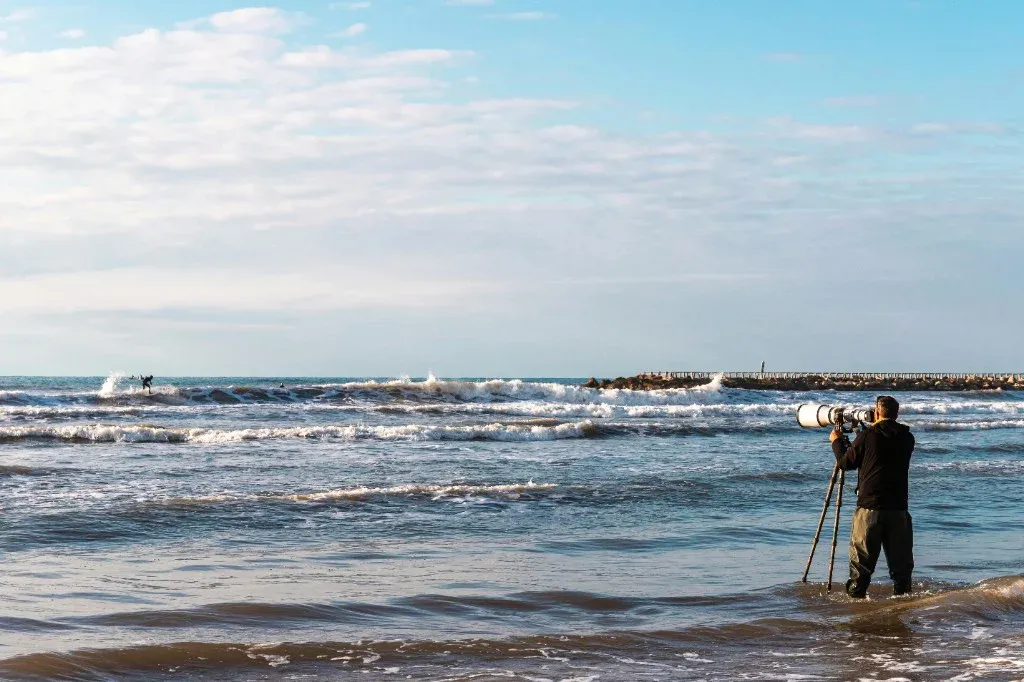
- Focal length needed: 200–400mm is typically enough — wakeboarders behind a boat are closer than a surfer at a beach break
- The wake as a compositional element: The twin wake lines behind the boat create leading lines toward the rider. Including them in the frame adds context and dynamism.
- Catching airs: Wakeboarders doing tricks off the wake follow a predictable arc. After watching a rider's pattern, you can anticipate where and when the jump will happen.
The reflection challenge
Flat water in calm conditions creates mirror-like reflections. This can be beautiful — a wakeboarder surrounded by a perfect reflection of sky and clouds — or distracting if the reflection is cluttered.
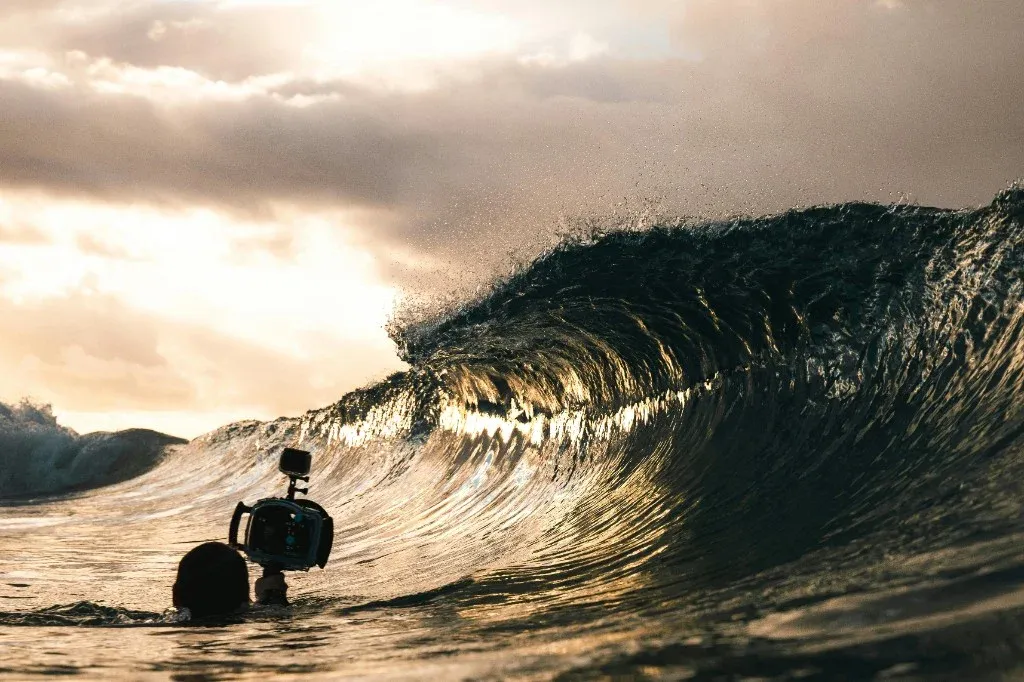
In very bright conditions, the water surface can blow out (too bright) while the rider is correctly exposed. Use exposure compensation to protect the highlights, or shoot with the sun behind you so the rider's face and the water surface are both evenly lit.
What wakeboarders buy
Similar to surf photography: riders want to see their tricks, their style, and their best moments. The shots that sell are:
- Aerial tricks at the peak: inverts, handle passes, grabs
- Rail tricks: Body position relative to the feature — shows skill and style
- Water-level shots: Low angle showing spray and energy
- The "steezy" clip: A style shot where the body position is perfect — even a relatively small trick can look great if the body position is clean
Selling wakeboarding photos
Riders want their photos while the session is still fresh. Share a gallery the same day, let the park and the riders know where to find it, and make each rider's frames easy to spot and buy.
If you also shoot kitesurf, windsurf or foil sessions, Onda turns them into sales: upload against the spot and date, and riders find and buy their own shots.

Cable parks are actually better commercial environments than ocean breaks in some ways: you know exactly who was riding when, the sessions are often booked in advance, and riders have already paid for their time on the cable (making a photo purchase feel like a natural extension of the day).
For ocean-based action sports photography, see our kitesurfing photography guide. The camera settings overlap significantly with our surf photography settings guide.