Kitesurfing Photography: How to Capture the Air Time
Published 15 June 2026
Kitesurfing photography is a different discipline from wave surfing photography. The scale is bigger, the motion is faster, the riders go much higher, and the sport's visual language — kite in the sky, rider in the air, water below — requires a different compositional approach.
What makes kitesurfing photography different
The third dimension: Wave surfers move primarily horizontally across the water. Kitesurfers move in all three dimensions — big airs can put a rider 15–20 metres above the water. Your framing has to account for a vertical range that surfing photography doesn't.
Distance: Kitesurf spots are often wide open beaches or flat water lagoons. Riders can be 200–500 metres from shore. You need more focal length than for typical surf photography.
Wind: Kitesurfing needs wind. You'll be shooting in strong, often gusty conditions. Sand, spray, and salt air are constant challenges.
Speed: Kitesurfers travel faster across the water than wave surfers. AF tracking needs to be aggressive, and your anticipation has to be sharper.
The kite itself: Unlike surfing, the kite is a major compositional element. How you include or exclude the kite fundamentally changes the feel of the image.
Gear for kitesurfing photography
Focal length
Most kitesurfing beach breaks require 400–600mm. Flat water lagoons (like the Canary Islands, Dakhla, or Tarifa) often require 500–600mm because the riders are far from shore.
For getting closer to the action (e.g. shooting from a boat or in the water), 200–300mm becomes useful.
Camera settings
| Setting | Value |
|---|---|
| Shutter speed | 1/2000–1/4000s for airs (faster for freezing rotor/bar movement) |
| Aperture | f/5.6–f/8 in good light |
| ISO | As needed — prioritise shutter speed |
| AF mode | Continuous tracking, subject detection |
| Burst rate | Maximum — airs are short and fast |
The key difference from surf photography: airs require even faster shutter speeds. A 15-metre kitesurf air at peak height happens fast — 1/2000s is a minimum to avoid any blur on the rider's extremities.
Anticipating airs
Kitesurfers telegraph big tricks before they happen. Watch for:
- The rider edging hard against the kite — they're loading the kite for an air
- The kite diving aggressively — power is about to come
- The rider's body position — dropping low before an air
Pre-focus on the rider and hold burst as they launch. You'll get more useful frames per session than waiting and reacting.
Positioning for kitesurfing photography
Downwind position
Position yourself downwind of the riding area — riders come toward you, giving you front-lit faces and the most dynamic angles. In cross-shore wind (the most common kitesurfing condition), one end of the beach will give you front-lit shots, the other will give you backlit ones.
Identify wind direction first, then choose your position.
Low angle
Shooting low (from the beach, sitting or lying) puts the sky as the background for airs, making the rider and kite stand out more clearly. Standing and shooting upward achieves the same effect.
Including the kite
Decide early whether your images will include the kite or focus on the rider alone.
- Including kite: The full picture of the sport — powerful, contextual, but compositionally complex
- Rider only (tight crop): Focuses on athleticism and expression, loses the sport's unique visual identity
Both are valid. The best kitesurf photographers are deliberate about this choice and consistent within a session.
Best spots for kitesurfing photography
Tarifa, Spain
The windiest city in Europe. The narrow strait between Europe and Africa creates a natural wind tunnel — the Levante (east wind) and Poniente (west wind) both create excellent kiting conditions.
Best for photography: The main Tarifa beach on Poniente days (west wind), where riders come toward the beach in good light. The mountain backdrop is dramatic.
Fuerteventura, Canary Islands
The north coast beaches — particularly Corralejo and El Cotillo — have consistent trade wind conditions almost year-round.
Best for photography: The flat water lagoon at Corralejo on low swell days; the ocean conditions on bigger swell days for more dramatic water backgrounds.
Dakhla, Morocco
A flat-water lagoon in southern Morocco. Famous for flat water freestyle and speed kitesurfing.
Best for photography: The lagoon gives clean, close access to riders. The desert landscape and warm light create a very different visual palette from European spots.
Essaouira, Morocco
Another strong wind location on Morocco's Atlantic coast. The old medina visible in the background of some shots creates unique context.
The moments worth capturing
The peak of the air: The highest point of the jump — rider fully extended, kite overhead or diving for the pull. This is the frame everyone wants.
The landing: Often more dramatic than the peak — the spray explosion as the rider hits the water.
The kite loop: A kite loop sends the kite spinning fast through the power zone. The resulting explosion of power and spray is chaotic and beautiful.
The unhooking sequence: Freestyle tricks done unhooked require the rider to control the bar with their hands — the body position during these tricks is athletic and visually interesting.
The wipeout: A big crash in kitesurfing is dramatic. The rider, the kite crashing into the water, the spray — all worth capturing.
Finding kitesurfing photos of yourself
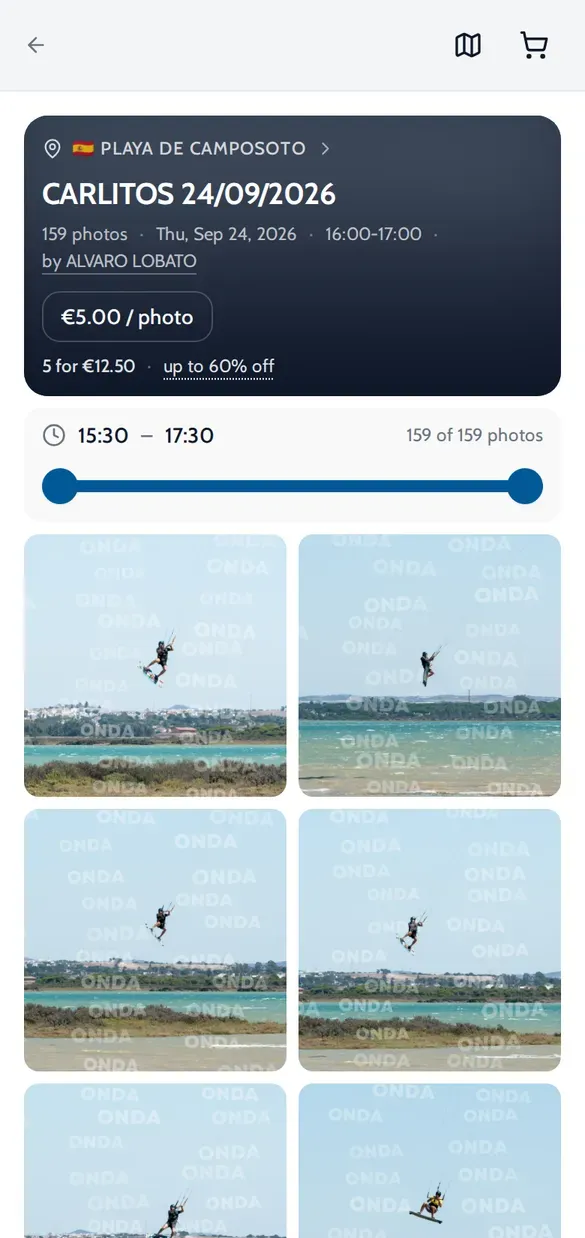
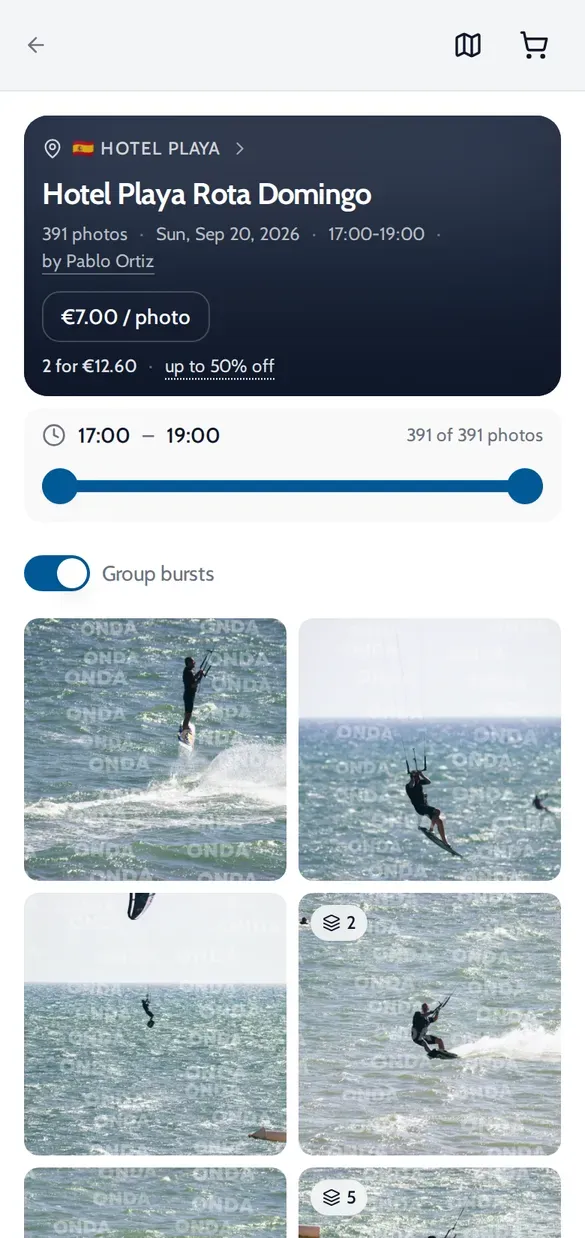
If you've been out at any busy kite spot recently, there's a fair chance a photographer was shooting. Search on Onda by location and date to find albums from your session.


For the Canary Islands specifically, trade winds make Fuerteventura and Lanzarote two of Europe most consistent kite spots. For cable and boat sports, see our wakeboarding photography guide.