Top 10 Surf Photographers in the World Right Now
Published 4 June 2026
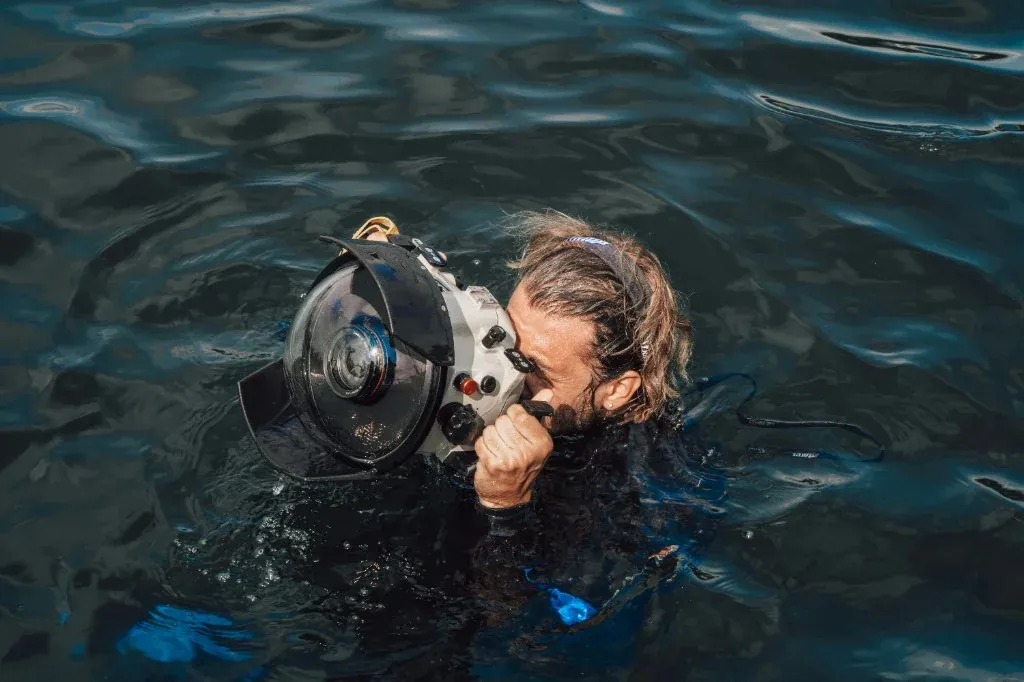
Surf photography has its own canon of legends — people who spent decades in the water, on the rocks, and on the cliffs building a visual language for the sport. But the field also has a current generation who are redefining what's possible with new technology, new access, and new creative approaches.
Here are the photographers whose work is most worth studying right now.
What makes a great surf photographer
Before the list: it's worth being clear on what separates a working surf photographer from an exceptional one.
Technical excellence is the baseline. Beyond that, the best surf photographers have:
- Wave reading: They know where the best moment will happen before it does
- Light awareness: They choose when and where to shoot based on how the light will interact with the water
- A distinct visual language: Their photos are recognisable without a watermark
- Relationship with the surf community: Access to elite surfers in non-competitive contexts produces different images than competition shooting alone
The photographers
Clark Little
The defining in-water shore break photographer. Clark Little built a career — and a significant commercial empire — around one specific technique: shooting from inside the lip of a breaking wave on Hawaiian shore breaks, specifically the North Shore of Oahu.
His photographs capture the refraction of light through moving water in a way that looks almost computer-generated, but is entirely natural. The technique requires being in an extremely dangerous position (inside a breaking shore break on sand) with precise timing.
What to learn from his work: How to use a single specialised technique, executed perfectly, to build an unmistakable visual identity.
Erik Aeder
One of the most technically accomplished ocean photographers working today. Aeder's work spans surfing, big wave, and ocean wildlife. His underwater photography in particular — images of massive waves from below the surface — has a quality that stops you in your tracks.
What to learn from his work: The value of technical preparation. Aeder's in-water positioning is extraordinarily precise.
Nate Lawrence (aka Nate Wrestling)
A photographer who crossed over from skateboard photography and brought that aesthetic with him — flash, fisheye, urban sensibility applied to ocean settings. His work has influenced a generation of younger surf photographers who wanted to shoot surf differently from the traditional telephoto-from-the-beach model.
What to learn from his work: How techniques and aesthetics from other disciplines can be applied to surf photography to create something fresh.
Joli (Brian Bielmann / Jimmicane)
Both Bielmann and Jimmicane (Alex Laurel) represent the tradition of high-volume, high-quality telephoto surf photography at its most developed — the photographers who are at every major event, in every major publication, year after year.
What to learn from their work: Consistency, professionalism, and the value of being present at every significant moment in the sport.
Morgan Maassen
A photographer who treats surf imagery as part of a broader vision — his work moves between fine art photography, surfing, and ocean culture. His Instagram and published work have a cinematic quality that owes as much to fashion and editorial photography as to traditional surf photography.
What to learn from his work: How treating surf as a subject within a larger artistic vision creates more universal appeal.
Andrew Shield
Based in Australia, Shield's work captures Australian surf culture at its most raw and authentic — the regional competitions, the country breaks, the less glamorous moments between perfect waves.
What to learn from his work: How authentic documentary photography of a surf community creates a different kind of value than chasing the most spectacular waves.
Ryan Craig
A New Zealand photographer whose long-exposure and creative technique work sits at the intersection of fine art and surf photography. His multiple-exposure shots of a single surfer's arc across a wave are immediately recognisable.
What to learn from his work: Technical creativity — using camera technique to visualise motion in ways that standard photography can't.
Looking across this list, a few patterns emerge:
- All of them have a specific, identifiable approach — you can recognise their work without seeing the name
- All of them have deep relationships with the surf community, particularly the surfers they photograph regularly
- All of them have put in years of work in difficult conditions, often for little financial return early in their careers
- All of them treat the ocean as more than a backdrop — it's a subject in its own right
For anyone building a career in surf photography, these photographers are worth studying not just for their technique but for how they've built sustainable creative practices in what is a genuinely difficult commercial field.
For deeper lessons from individual photographers, see what every surf photographer can learn from the legends. And if you are just starting out, our beginner guide to surf photography covers the fundamentals.

Sell your sessions on Onda — built by and for surf photographers →